From Saved Post to Skin: How to Actually Turn Your Tattoo Inspiration Into the Real Thing
Let's set the scene. You've been collecting tattoo inspiration for months — maybe years. Your camera roll has a dedicated folder. Your Pinterest board is an organized chaos of botanical line work, geometric blackwork, watercolor florals, and three completely different styles that somehow all feel like you. You're ready to commit. But the second you imagine actually sitting down with an artist and describing what you want, your brain goes blank.
You're not alone. First-time clients walk into studios every single day with incredible vision and almost no idea how to communicate it. The good news? Translating inspiration into tattoo-ready artwork is absolutely a learnable skill — and it starts way before you ever book your appointment.
Step One: Stop Saving Everything and Start Editing
The first instinct most people have is to compile as much inspiration as possible. More references, more options, more ideas. But here's the thing — showing an artist 200 saved posts isn't helpful. It's overwhelming, for both of you.
Your first real task is to edit ruthlessly. Go through everything you've collected and ask yourself one question for each image: Is this the vibe, or is this the exact thing? You want a mix of both, but you need to know which is which.
Pull out maybe ten to fifteen images maximum. Within that group, look for patterns. Are you consistently drawn to fine line work or bold outlines? Dark shading or minimal color? Realistic imagery or illustrative styles? Those patterns are telling you your actual aesthetic, even if you can't name it yet.
Step Two: Learn the Language (Just Enough of It)
You don't need to become a tattoo historian overnight, but knowing a handful of style names will make your consultation infinitely smoother. Here's a quick cheat sheet:
- Fine line / Micro realism — delicate, detailed work with thin lines, often in black and gray
- Traditional / Neo-traditional — bold outlines, solid fills, iconic Americana imagery or its more illustrative modern cousin
- Blackwork / Geometric — strong contrast, patterns, shapes, minimal or no shading gradients
- Illustrative — looks like it could live in a high-end art book; lots of variation in line weight and texture
- Watercolor — soft, blended color with loose edges, often without heavy outlines
- Japanese / Irezumi-influenced — flowing compositions, specific iconography like koi, dragons, chrysanthemums, bold outlines
Knowing which of these resonates with your saved images helps you search for artists who specialize in exactly what you're envisioning — and trust us, specialization matters enormously in tattooing.
Step Three: Build a Real Mood Board, Not Just a Screenshot Dump
Once you've narrowed your references and identified your style leanings, it's time to build something an artist can actually use. A proper mood board for a tattoo consultation should include:
Style references — images that capture the technique you want, even if the subject matter is completely different from your design
Subject references — photos of the actual object, animal, plant, or symbol you want rendered, ideally from multiple angles
Placement references — photos showing where on the body similar tattoos sit, so the artist understands the scale and flow you're imagining
What you don't want — this one is underrated. If there's a version of your concept that exists and you hate it, include it. Knowing what to avoid is just as useful as knowing what to pursue.
Keep it organized. A shared Google Slides deck, a Canva board, or even a printed-out folder works beautifully. The goal is to hand something to your artist that tells a clear visual story.
Step Four: Find the Right Artist — Not Just Any Artist
This is probably the most important step, and the one beginners most often skip. Tattoo artists are not interchangeable. A brilliant traditional tattoo artist may not be the right fit for delicate micro-realism. An incredible portrait specialist might not be your person for geometric blackwork.
Spend real time looking at portfolios. On Instagram, on studio websites, on artist-specific pages. You're not just looking for quality — you're looking for evidence that this artist has done work similar to what you want and done it well.
When you find someone whose portfolio makes you think "yes, that's exactly it" — that's your artist.
Step Five: The Consultation Is a Conversation, Not an Audition
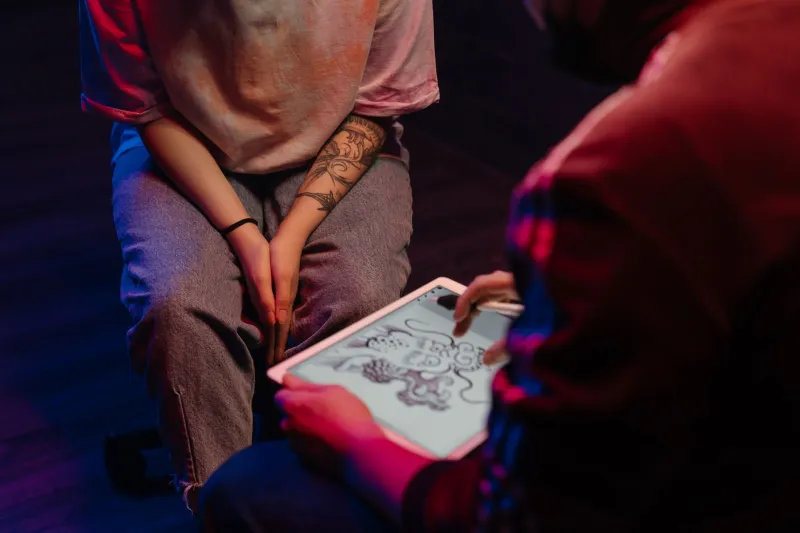
A lot of first-timers walk into consultations feeling like they need to prove they deserve the artist's time. Flip that script. A good consultation is a creative dialogue, and you're a full participant in it.
Come prepared with your mood board, a clear sense of your preferred style, your placement idea, and a rough size in mind. But also come ready to listen. An experienced artist will tell you things like:
- "That level of detail won't hold up long-term at that size"
- "That placement is going to distort as you move — here's an alternative"
- "The watercolor effect you want works better without a white highlight background over time"
These aren't criticisms. They're expertise. Take notes, ask questions, and trust that a collaborative back-and-forth will get you somewhere better than either of you started.
Common First-Timer Mistakes to Dodge
Bringing in someone else's exact tattoo. References are great. Asking for a copy of another person's custom piece is a big no. Artists want to create something original for you, and the best ones will decline to duplicate.
Choosing placement based only on aesthetics. Some spots age differently, hurt more, or don't hold ink the same way. Your inner bicep is not the same canvas as your forearm. Ask about this.
Going too small for the design complexity. Intricate details in a tiny tattoo often blur into a blob within a few years. If you love the complexity, size up.
Booking the cheapest option. Tattoos are permanent. This is not the place to bargain hunt. A higher hourly rate from a skilled artist is almost always worth it.
Rushing the process. The best custom work takes time — sometimes weeks of back-and-forth before a design is finalized. That's not a red flag. That's care.
You're Ready
Getting your first tattoo should feel exciting, not stressful. With a little prep work, the right references, and the right artist, what starts as a scattered collection of saved posts can become something you'll carry with you — beautifully, permanently — for the rest of your life.
At Splash of Ink, we believe every client deserves to walk out of a session feeling like the art on their skin is exactly, completely, unmistakably theirs. That starts with showing up prepared. And now, you are.