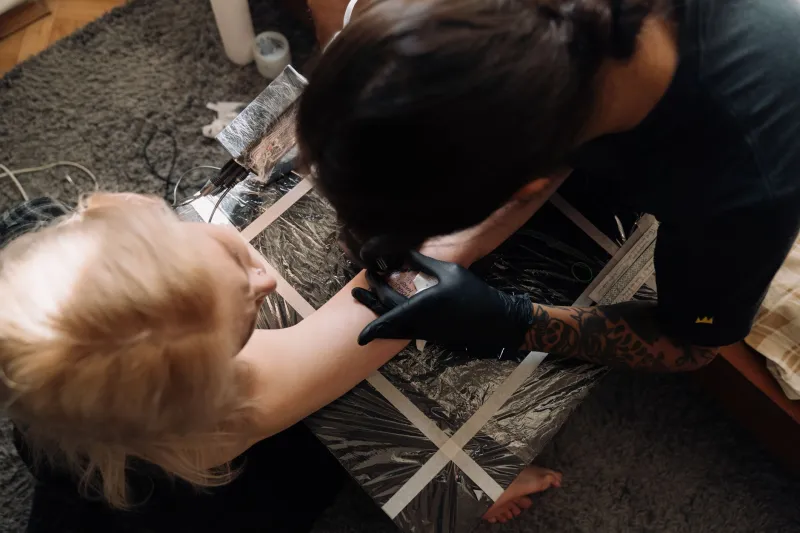
One Permanent Decision That Changes How You Make All the Others

Most people walk into a tattoo studio thinking about placement, design, and whether they can handle the needle. Very few walk in thinking, this might change the way I handle my boss, my relationships, or my next big life move. But that's exactly what a growing number of people—and a handful of researchers—are starting to notice.
There's something about committing to something permanent on your own body that seems to rewire how you approach decisions in general. Call it the tattoo ripple effect. Once you've sat in that chair and said yes to something that's never coming off, the smaller stuff starts to feel a little more manageable. And the bigger stuff? A little less terrifying.
What Happens in Your Brain When You Choose Something Permanent
Decision-making is a muscle. Like any muscle, it gets stronger the more you use it—especially when the stakes feel real. Psychologists who study commitment and identity formation have long noted that major, irreversible choices tend to create what's called post-decisional consonance. In plain English: once you've made a decision you can't undo, your brain works overtime to align your self-image with that choice. You stop second-guessing. You start owning it.
Tattoos are one of the most personal and visible forms of that kind of commitment. Unlike quitting a job or ending a relationship—choices that are permanent in their own way but often feel forced—getting inked is almost always a deliberate, autonomous act. You chose it. You planned it. You sat through it. That sense of agency is a big deal psychologically.
Research into self-expression and identity suggests that when people make visible, body-level commitments, it reinforces a stronger, more stable sense of self. And a stable sense of self is basically the foundation of confident decision-making.
The Stories People Tell After the Chair
Talk to people who've gotten meaningful tattoos and you'll hear a pattern emerge—not always right away, but over months and years. There's often a before and after, and it's not just about the art.
Take someone who spent years staying in a job they'd outgrown, telling themselves they'd figure it out eventually. They get a tattoo that represents something they'd always believed about themselves—a value, a memory, a version of who they wanted to be. Suddenly, that belief is no longer abstract. It's on their body. It's real. And something about that tangibility makes it harder to keep living out of alignment with it.
Or consider the person who always struggled to set limits with family members—always saying yes when they meant no. They get a piece that symbolizes their own autonomy, something they chose entirely for themselves. And slowly, the muscle memory of choosing themselves in the studio starts showing up in how they navigate holiday dinners and phone calls that run too long.
These aren't magic stories. They're not claiming that ink heals everything. But there's a thread running through them that's hard to ignore: making a bold, deliberate choice about your own body teaches you something about what it feels like to choose boldly, period.
Why Irreversibility Is the Point, Not the Problem
Here's where it gets interesting. Most people outside the tattoo world treat permanence as the scary part—the thing to warn you about, the reason to think twice, the source of potential regret. But for a lot of people who've gone through the experience, permanence is actually the whole point.
When you make a reversible choice, there's always an escape hatch. You can undo it, take it back, pretend it didn't happen. That option, while comforting, also keeps you from fully committing. It keeps one foot out the door.
With a tattoo, there's no foot out the door. You're in. And that full-body buy-in—literally—teaches you something about what it feels like to stop hedging. To stop waiting to see how things play out before you decide how you feel about them. To just... decide.
Career coaches and therapists in the US have increasingly noted that clients who struggle with chronic indecision often benefit from practicing exactly this kind of irreversible commitment in lower-stakes areas of life. For some people, a tattoo becomes that practice ground. You prove to yourself that you can make a call, live with it, and come out fine on the other side. Sometimes better than fine.
The Identity Anchor Effect
There's another layer to this worth talking about, and it has to do with how visible your commitment is—to yourself and to others.
Every time you catch a glimpse of your tattoo—in the mirror, reaching for something, rolling up your sleeve—you get a small but real reminder of a choice you made. A choice that reflected something true about you. Over time, those micro-reminders function like an identity anchor. They keep pulling you back to a clearer sense of who you are and what you value.
That clarity matters more than people give it credit for. A lot of the anxiety that surrounds big decisions—career pivots, ending relationships, starting something new—comes from not being sure who you are or what you actually want. When your values are literally written on your skin, that ambiguity has less room to grow.
This isn't about turning your body into a vision board. It's about the way external symbols of internal truth can reinforce your sense of self in ways that are subtle but cumulative.
It's Not a Cure-All, But It's Not Nothing Either
Let's be real: getting a tattoo isn't going to fix a fear of commitment or hand you a promotion. It's not therapy, and it's not a shortcut. People who get inked for the wrong reasons—to prove something to someone else, to fill a void, to make a decision they haven't actually made internally—don't always experience this kind of shift.
But for people who approach it as a genuine act of self-expression and self-determination, the effects can be quietly profound. The confidence that builds in the studio—the willingness to say yes, this is what I want, and I'm ready to live with it—has a way of showing up in other rooms, at other tables, in other conversations.
At Splash of Ink, we talk a lot about what happens on the skin. But some of the most interesting things happen just beneath the surface—in the mind, in the gut, in the slow accumulation of choices that shape who you're becoming.
Maybe that next tattoo isn't just a piece of art. Maybe it's a little bit of practice for the rest of your life.